




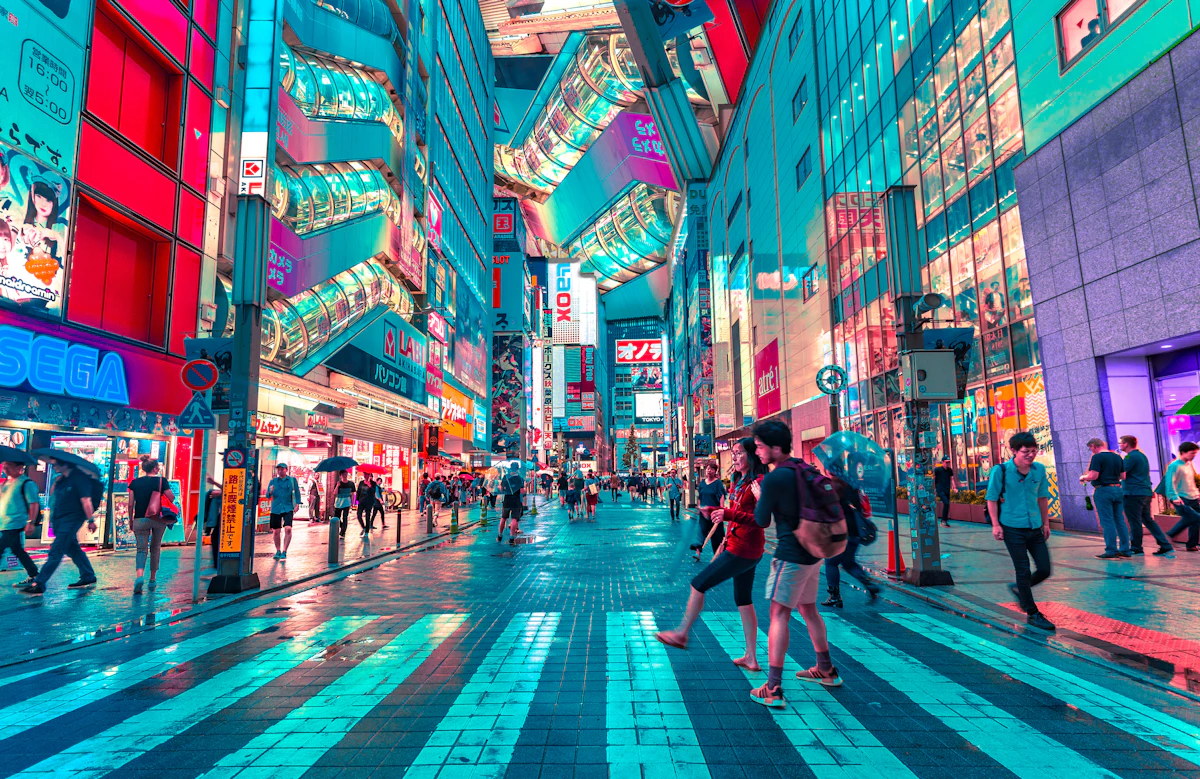
Neon ghosts haunt a perfectly ordered machine.
TOKYO
Tokyo exists in the friction between the hyper-accelerated tomorrow and the hushed, incense-heavy yesterday. It is a city of thirty-seven million people where you can stand in the middle of Shinjuku’s kaleidoscopic scramble crossing and feel more profoundly alone than you would in a desert. This is not a paradox; it is the fundamental operating system of the metropolis, where intimacy is curated in tiny, subterranean bars and public life is performed with a polite, impenetrable distance. To walk these streets is to engage in a silent, high-stakes choreography with a population that prides itself on being unseen. You are always a ghost here, moving through a landscape that is constantly being erased and rewritten by a relentless, industrial hand. It is, perhaps, the only place on earth that manages to be simultaneously the most welcoming and the most indifferent home you will ever encounter.
The myth of Tokyo—the one sold on Instagram and in travel brochures—is a sanitized fever dream of cherry blossoms and orderly robots. In reality, the city is an aggressive, sweating organism of concrete, where the 'lost' neighborhoods like old Shimokitazawa are being devoured by luxury high-rises and soulless retail chains. Tourists arrive expecting a polite, quiet sanctuary, only to find a frantic, cacophonous urban sprawl that demands constant sensory navigation. The traditional wooden architecture is increasingly a decorative veneer, hiding seismic-proof steel skeletons that groan under the weight of sheer density. While the city pretends to be a preservationist’s paradise, it is actually a ruthless engine of modernization, discarding the obsolete with a efficiency that borders on the cruel. If you look for the Tokyo of your imagination, you will only find the disappointment of a consumerist trap; if you look for the friction, you will find the truth.
Social life in Tokyo is a delicate game of exclusion, governed by a rigid, unspoken code that tourists violate the moment they raise their voices in a crowded train car. The city is segregated not by law, but by the impenetrable wall of language and the social exhaustion of its weary, overworked salarymen. Locals view the current deluge of tourism with a polite, strained tolerance—the 'omotenashi' hospitality is real, but it is a service-industry mask that rarely translates to genuine friendship. Class tensions manifest in the sharp divide between the gleaming, internationalized hubs like Roppongi and the aging, stagnant pockets of the working-class 'shitamachi' districts. To navigate Tokyo successfully, one must learn to vanish into the background, practicing the art of 'kuuki wo yomu'—reading the air—to avoid being the loud, clumsy outlier. This is a society that values the collective harmony above your individual desire for a convenient, English-friendly interaction.
Budgeting for Tokyo requires a sobering recognition that while the yen is weak, the cost of genuine quality remains stubbornly high. For a comfortable, mid-range experience, expect to budget at least $150–$200 per day; anything less will force you into the claustrophobic purgatory of capsule hotels and convenience store meals. Transportation is a masterclass in efficiency, but the web of JR lines and private metros can bankrupt your Suica card if you don't stick to a single route. Solo travelers are the ultimate demographic here; the city is built for the individual, with single-person ramen booths and tiny izakaya counters that make dining alone an act of quiet dignity. Avoid the common mistake of trying to 'see it all'—Tokyo is a series of villages, not a singular destination, and attempting to traverse from Asakusa to Shibuya in one day will leave you exhausted and disillusioned. Visit in November or May to avoid the oppressive, suffocating humidity of summer or the bitter, bone-dry chill of a Tokyo winter.
The soul of the city hides in the places that refuse to be polished for the tourist gaze, tucked away in the shadows of the elevated train tracks. Seek out the narrow, smoky alleys of Omoide Yokocho in Shinjuku, not for the food, but for the smell of charcoal smoke and history that clings to the walls. Spend your evenings in the small, jazz-infused kissaten of Jimbocho, where the smell of old paper and roasted beans creates a sanctuary against the neon glare outside. Wander through the quiet, residential backstreets of Yanaka, where the pace of life slows to a crawl and the local cat population outnumbers the visitors. Visit the neighborhood sentos—the public bathhouses—where the steam hides your identity and you sit shoulder-to-shoulder with the real inhabitants of this city. This is the unvarnished heart of Tokyo, existing in the quiet moments between the rush hour trains and the closing of the shutters.
Tokyo is not a destination for the casual traveler seeking a relaxing vacation; it is a pilgrimage for those who want to feel the sheer scale of human ambition. You will leave with your feet aching, your wallet lighter, and your understanding of civilization fundamentally challenged. Visit only if you are prepared to be frustrated, overwhelmed, and completely ignored by a culture that owes you nothing. You will gain a rare, sharp-edged clarity about the modern world, but you will lose the illusion that you can ever truly know a place from the outside. To enter Tokyo is to be humbled by the impossible machinery of life itself.
The Micro-Economies of TOKYO
Shimokitazawa
Defined by the intersection of Kitazawa and Daita, this is the bohemian heart where thrift store culture meets live music. It’s a mix of starving artists, hipsters, and long-term elderly residents living in quiet post-war homes. Accommodation averages $120–$180, trending upwards due to gentrification. During the day, it is a sleepy neighborhood of vintage shops; at night, the tiny bars turn into vibrant, chaotic hubs. It is worth staying here to experience the 'real' youth culture, away from the corporate centers.
Yanaka
Centered around the Yanaka Ginza shopping street, this area survived the bombings and retains a nostalgic, pre-war atmosphere. The residents are primarily elderly, and the vibe is profoundly quiet, smelling of incense and street-side croquettes. Prices are moderate, with traditional ryokans starting at $150 per night. It feels like a small village lost in time, perfect for a slow morning walk. Visit for a few hours, but stay elsewhere if you crave the neon pulse of the city.
Ebisu
Ebisu is an upscale residential enclave where young professionals flock for the dining scene near Ebisu Station and the Yebisu Garden Place. The streets are clean, wide, and remarkably quiet despite the central location, reflecting the higher socioeconomic status of its inhabitants. Hotels here are expensive, often topping $250, reflecting the premium on space and convenience. It is the perfect place to stay if you want an 'easy' Tokyo experience with proximity to everything. The nightlife here is sophisticated, lacking the grittiness of Shinjuku.
Koenji
Centered on the streets surrounding JR Koenji Station, this neighborhood is the gritty, punk-rock sibling of the more polished districts. It is a mix of counter-culture rebels, working-class families, and older shopkeepers who have been there for decades. You can find guesthouses for under $80, making it a budget traveler’s dream. The vibe is raw and unfiltered, with smoky izakayas dominating the scene at night. Definitely stay here if you prefer a lived-in, authentic atmosphere over luxury.
Kagurazaka
Once a geisha district, the narrow, winding streets of Kagurazaka now house high-end French bistros and traditional Japanese kaiseki restaurants. It is an intersection of old-world charm and modern, expensive taste, populated by wealthy locals and expats. Accommodations are pricey, rarely dipping below $200, though the aesthetic value is immense. It is a place for dining and wandering rather than partying, best suited for those who appreciate quiet, architectural beauty. Visit for a dinner that feels like a secret kept from the masses.
Asakusa
Asakusa revolves around the Senso-ji temple and the Nakamise-dori market, drawing a relentless tide of tourists that never seems to ebb. The locals here are tired of the crowds, yet they maintain a sense of deep, traditional pride in their historic district. You can find cheap hostels for $50, though the quality varies wildly and the area loses its charm as soon as the temple gates close. It is a quintessential tourist base, fine for a two-day stay, but quickly becomes claustrophobic for any longer.
Micro-Economy & Cost Breakdown
Transportation in Tokyo is a religion of timing; the JR Yamanote line is your iron spine, while the Tokyo Metro handles the delicate capillaries of the city. A single ride costs roughly $2–$3, but the real cost lies in the complexity of transfers between different rail companies. Avoid taxis at all costs; a cross-town trip from Shinjuku to Ginza can easily run you $60–$80, and you will be stuck in the exact same traffic you were trying to escape. Save your sanity and money by purchasing a Welcome Suica card immediately upon arrival, which covers almost all transit and convenience store needs. Reliability is absolute, provided you avoid the 8:00 AM rush hour, which is a physical collision of bodies you should experience exactly once.
Accommodation in Tokyo is a study in vertical living, where you pay handsomely for a square of carpet and a view of a brick wall. Budget travelers can find adequate business hotels in districts like Ueno or Ikebukuro for $100–$130, while luxury seekers should look toward the high-rises of Shiodome or Akasaka for $400+. Avoid the 'Airbnb' trap, as many listings are illegal, poorly managed, or located in inconvenient residential zones far from the trains. The sweet spot for value is a well-rated business hotel chain like Dormy Inn, which offers communal hot springs and free evening ramen. Book at least three months in advance, as the best value rooms evaporate with the same speed as the city's seasonal snow.
Dining in Tokyo is an economic paradox: you can eat a world-class meal for $12 or a mediocre one for $100. The secret is the 'shokudo' (casual eatery) or the ticket-machine ramen shops found near train station exits, where a steaming bowl of tonkotsu costs a mere $8–$12. Avoid any restaurant with a massive English-only menu and a 'tourist set' price, as these are invariably lower-quality traps. For the best ingredients, visit the outer markets of Tsukiji early in the morning and eat what the vendors eat—fresh sashimi on rice for under $15. Eat like a local by following the queues of suits; if the salarymen are waiting, the quality is guaranteed and the price is honest.
Avoid Tokyo in the sticky, oppressive heat of July and August, when the humidity turns the city into a giant, concrete sauna and the heat island effect becomes unbearable. The secret shoulder season is mid-October through November, when the air is crisp, the sky is a sharp blue, and the gingko trees turn the streets gold. You need at least seven days to stop being a tourist and start being an observer, as the first three days are inevitably spent recalibrating to the frantic pace. Do not try to jam Kyoto or Osaka into a five-day Tokyo trip; you will spend your entire vacation on a bullet train, seeing nothing but the blur of the countryside. Tokyo rewards the slow, deliberate traveler who is willing to stay in one district and actually walk its streets.
Culinary Reality
Survival Protocols
- The 'Friendly' Local Scam:A 'local' will approach you in Roppongi or Shinjuku, speaking perfect English, claiming to know the 'best' bar that isn't on the internet. They will escort you inside, where you are presented with a massive, hidden cover charge or a bill for thousands of dollars. Never follow a stranger who initiates conversation in a nightlife district, no matter how charming they seem. Walk away immediately and stick to established, crowded bars with posted prices.
- The Suica/Pasmo Confusion:Tourists often try to buy individual paper tickets for every single train journey, which is a massive waste of time and money. You end up standing in long queues at machines every time you move between lines. Buy a Welcome Suica or Pasmo card at the airport, or add it to your Apple Wallet, and tap through every gate. It saves you hours of frustration and prevents the 'wrong fare' penalty at exits.
- Walking and Eating/Talking:It is considered deeply rude to walk down the street while eating or to have a loud conversation on your phone in public spaces. Locals value the sanctity of the 'in-between' spaces; eating should be done stationary at a stall or in a shop. Keep your phone on 'manner mode' and keep your voice to a whisper in transit. Observe the silence around you and mirror the volume of those nearby.
- The Summer Humidity:July and August are not just 'hot'; they are an endurance test of 90% humidity that makes you feel like you are walking through soup. The temperature often exceeds 95°F (35°C), and the air is completely stagnant in the concrete canyons of the city. Locals cope by carrying small towels to wipe sweat constantly and ducking into air-conditioned 'konbini' stores every fifteen minutes. If you visit then, you must prioritize hydration and accept that you will be constantly damp.